

Przemysl State Archive
Przemyśl State Archive is known in Poland and abroad because of the resources as follows:
- Fond 142 – Vital records of Greek Catholic church of Przemysl Diocese. Przemysl Greek Catholic Diocese was delegalized after WW2 and all vital records were moved to Przemysl State Archive.
Link to the fond:
https://www.szukajwarchiwach.gov.pl/en/zespol/-/zespol/125912
If you look for particular town e.g. Stubno you click on List of files andyou type Stubno and you have results:
We can see that Greek Catholic records of Stubno are available from 1784 to 1871
Fond 142 does not have only vital records but also other precious documents like parchment and paper documents of Royal and papal office from 1291 – 1923 (privileges for the church, for clergy and faithful of Eastern rite, act of nomination for the bishop, documents regarding creation of GC churches, property matters, buy sell contracts of rectories and church land) There are also dean’s visitations and statistical data about diocese (lists of parishioners and parishes of each deanery, descriptions of churches, inventories of churches and parish buildings, diocesan schematisms. There are also church authorities documents (encyclics and apostolic letters of the church, diocesan synods records, directives and pastoral letters of bishops, central authorities of Diocese records). There are state authorities records regarding Przemyśl GC bishop (extracts from land and city records, Austrian authorities documents) We have here also documents regarding diocesan clergy and records regarding monasteries and religious organizations. There are diocesan institutions records and financial documents regarding estates belonging to Przemysl GC bishop. There are also school records in diocese.
- Fond 126 – Geodetic Archive.
This fond consists of hundreds of towns and villages with their maps from 1850’s and documents called operats. Operats have documents that allows to locate on the map ancestral house and fields that each farmer owned. I attach separate document with list of maps of towns that are in Przemysl. Majority of these towns has also operats.
Link to find 126:
https://www.szukajwarchiwach.gov.pl/zespol/-/zespol/125896
The towns from letters A to L are available online.
You click on Series and you have list of towns:
If you want to check what maps is available from e.g. Stubno you click on list of files:
and in the field name of fonds you type Stubno
We can see that there is Stubno map from 1849:
The information on how to locate ancestral house is on my facebook page here:
https://www.facebook.com/polishrecords
List of house and land owners from Galicia from 1780’s and 1820 so called Metryka Józefinska and Franciszkańska are located in Lviv State Archive. I attach the inventory of all towns that can be found there. I attach also list of maps in Rzeszow State Archive.
- Roman Catholic vital records from Przemysl Diocese.
Majority of them start around 1890 and the older ones are in in Przemysl Catholic Archive. These vital records were kept in Civil Registry Offices and when they became older than 100 years in case of births and 80 years in case of marriage/deaths they were moved to Przemysl State Archive. Part of Civil Registry Office books from south eastern Poland are also in Sanok and Rzeszow State Archive. We do not have all records that are more than 100 or 80 years old because very often they were in one book. It means that these books will be moved to the Archive when they are 80 or 100 years old. In case of marriages and deaths it can be in 2025.
How to check your ancestral town? You click on link:
https://www.szukajwarchiwach.gov.pl/en/strona_glowna
The you type ancestral town e.g. Kaszyce:
https://www.szukajwarchiwach.gov.pl/en/wyszukiwarka
And then you click on Pradziad
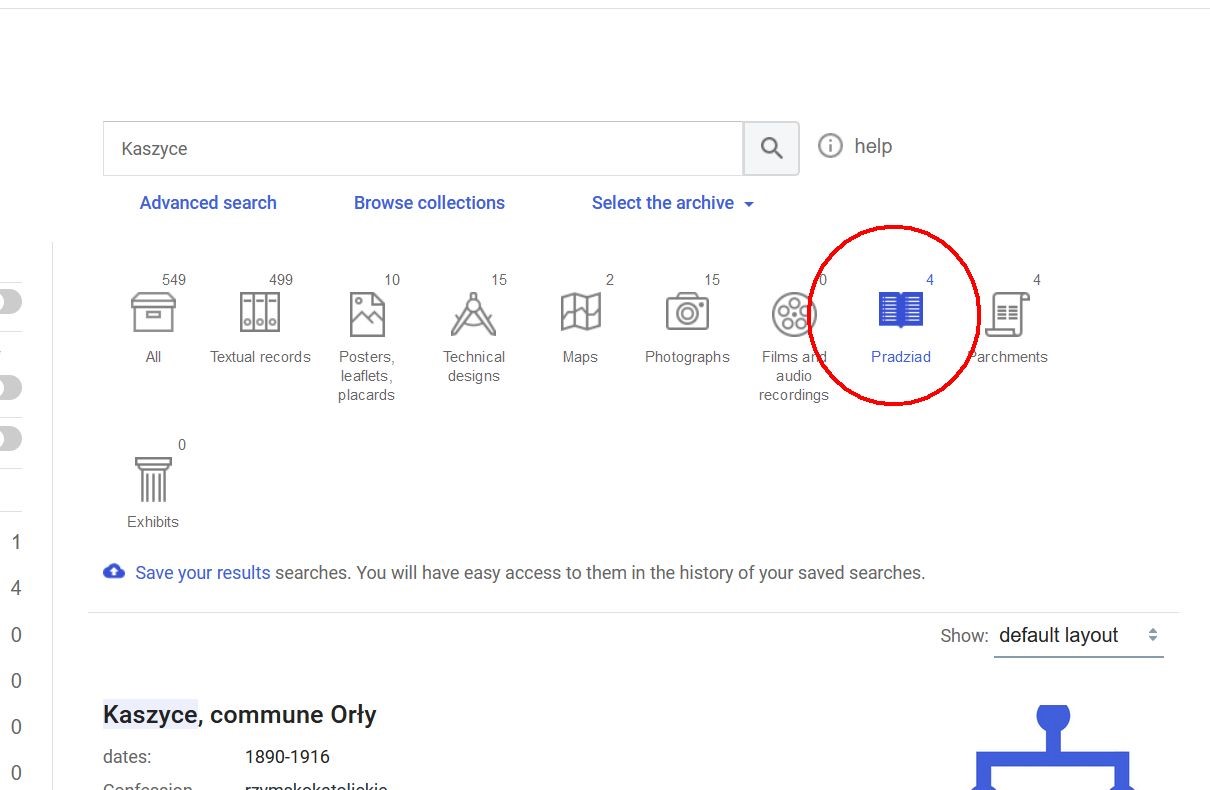
Here we can see that Kaszyce records are available from 1890 to 1916.
The easiest way to view the scans is as follows:
- Click on Kaszyce Commune Orły:
https://www.szukajwarchiwach.gov.pl/en/zespol?p_p_id=Zespol&_Zespol_javax.portlet.action=zmienWidok&_Zespol_nameofjsp=pradziad&_Zespol_id_zespolu=90008239&_Zespol_rowId=9000037710&_Zespol_cur=1 Click on Reference code
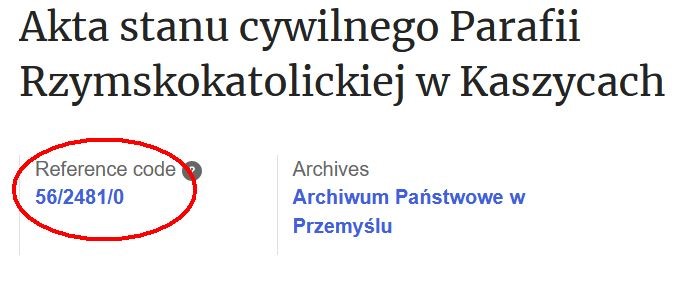
https://www.szukajwarchiwach.gov.pl/en/zespol/-/zespol/158556\
- Click on list of files:
- Click on Księga urodzeń, małżeństw i zgonów (birth, marriages and deaths)
https://www.szukajwarchiwach.gov.pl/en/jednostka/-/jednostka/34093555
- Click on select all and then download. Thus you will have all scans of Kaszyce town
- Notary records
How to quickly find what Notary records that are available in Przemysl. Click on this link:
https://www.szukajwarchiwach.gov.pl/en/web/archiwum-panstwowe-w-przemyslu/zespoly
Type in the film name of the fonds Notariusza:
Then you will have all notaries available in Przemysl State Archive from the towns as follows:
- Biecz
- Bircza
- Bóbrka
- Bukowsko
- Brzozów
- Cieszanów
- Dębica
- Dobromil
- Dubiecko
- Dukla
- Dynów
- Frysztak
- Głogów Małopolski
- Gorlice
- Jarosław
- Jaworów
- Kolbuszowa
- Komarno
- Krakowiec
- Krosno
- Lubaczów
- Leżajsk
- Lutowiska
- Łańcut
- Mielec
- Mościska
- Nisko
- Niżankowice
- Pilzno
- Pruchnik
- Przemyśl
- Przeworsk
- Radomyśl
- Radymno
- Ropczyce
- Rozwadów
- Rymanów
- Rzeszów
- Sanok
- Sądowa Wisznia
- Sieniawa
- Sokołów
- Strzyżów
- Tarnobrzeg
- Tyczyn
- Ulanów
- Ustrzyki Dolne
- Zassów
Notary records have buy-sell contracts, pre-marital contracts, donations, testaments, legalization protocols, indexes, promissory notes, statements, security deposits, abolition of co-ownership agreements. Documents of special interests are so called Repertorium – it consists of list of all cases with surnames of parties. Thanks to this document we can quickly check who is in the notary records. Alphabetical indexes are also very helpful with finding the person we look for.
- School Records
You need to enter this link of advanced search:
https://www.szukajwarchiwach.gov.pl/en/wyszukiwarka-zaawansowana
In the fileds It contains all of the words you type e.g. Szkoła (or Gimnazjum – old name for secondary school) and then e.g. Przemyśl
and then search
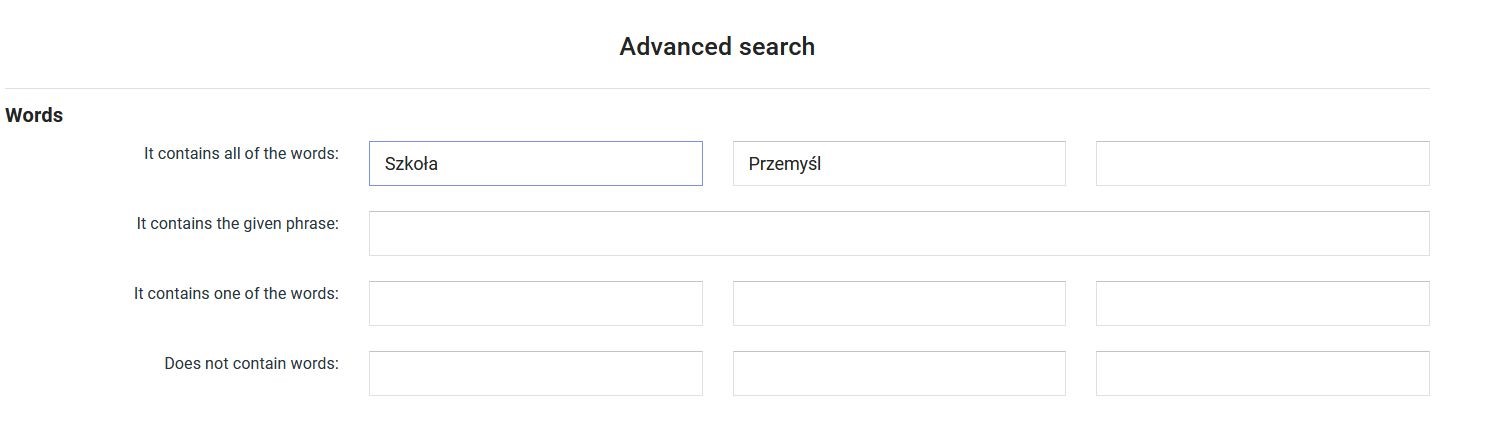
If we look for records from 1800’s we can narrow down the research to 19th century:
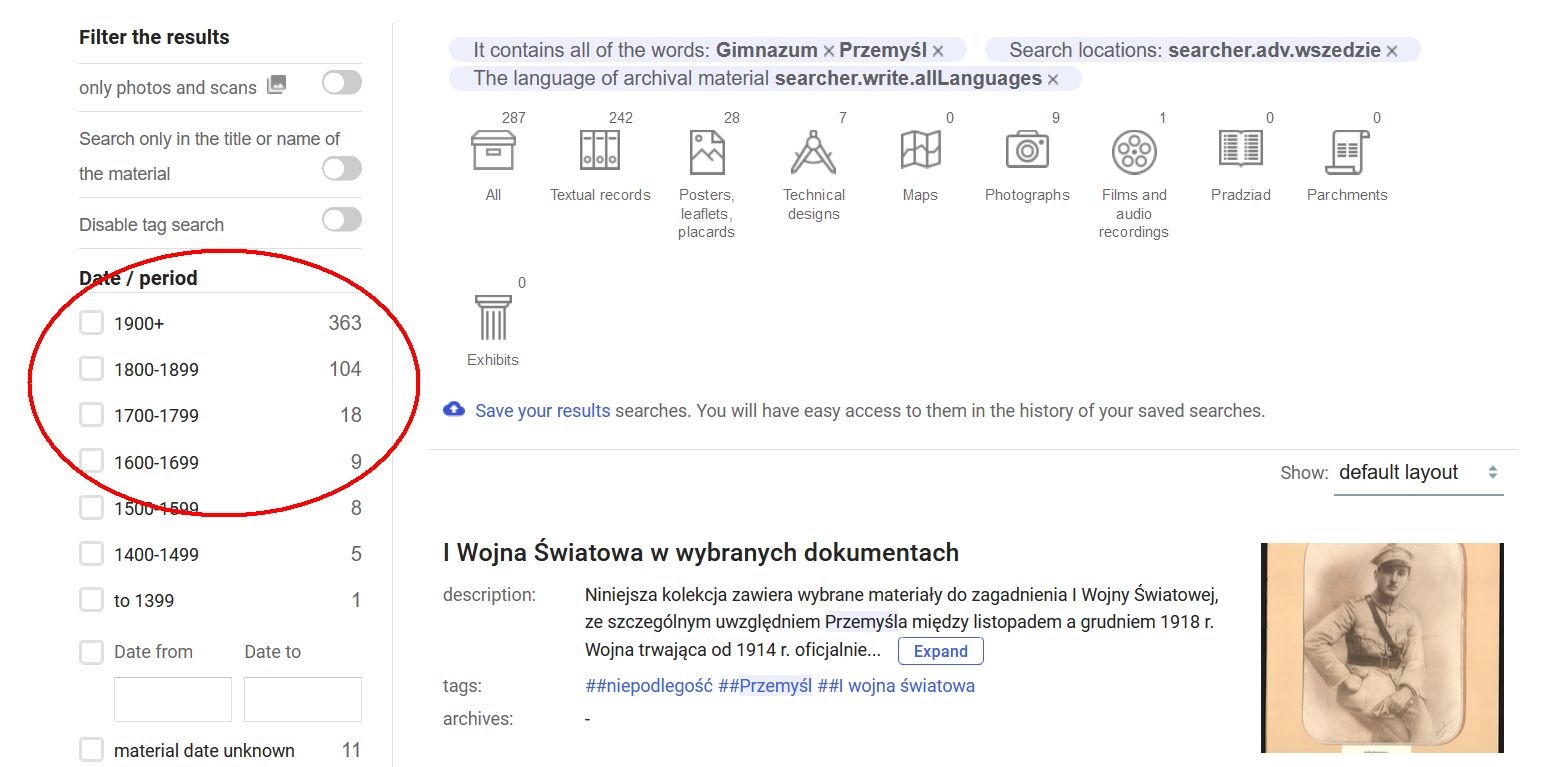
School records have information of parents of student, date of birth and nationality.
School records consists of classification catalogues and school attendance, school reports, protocols of meetings of pedagogical council, chronicles of school, grade sheets, class schedules, lists of students, school activities reports, youth organizations activities reports,
- Judiciary records
The situation with judiciary records is as follows; you can photograph the records that are more than 100 years old only and you can view the records that are more 70 years old. Many records and the information who they concern are not available on https://www.szukajwarchiwach.gov.pl/en/strona_glowna because of privacy law. The cover of records has the name of the person they concern.
In order to check what court is in Przemysl you enter this link:
https://www.szukajwarchiwach.gov.pl/en/web/archiwum-panstwowe-w-przemyslu/zespoly
Then in the field name of fonds you type Sąd (court)
We can see that we have courts as follows:
- Biecz
- Bircza
- Błażowa
- Brzozów
- Bukowsko
- Cieszanów
- Dębica
- Dubiecko
- Dukla
- Dynów
- Frysztak
- Głogów
- Gorlice
- Jasło
- Kolbuszowa
- Krakowiec
- Krosno
- Lubaczów
- Łańcut
- Mielec
- Mościska
- Nisko
- Niżankowice
- Pruchnik
- Przemyśl
- Przeworsk
- Radomyśl Wielki
- Radymno
- Ropczyce
- Rzeszów
- Sambor
- Sanok
- Sądowa WIsznia
- Sieniawa
- Sokołów
- Strzyżów
- Tarnobrzeg
- Tyczyn
- Ulanów
- Żmigród
In the judiciary records we will find heirship cases, testaments, guardianship matters, criminal records, civil cases, mortgage records, registers of civil trials, land records, maps.
- Commune records in the Archive:
In order to check what commune (Gmina) records are in the Archive you type Gminy here:
Then you will have the names of all commune records that can be found in Przemysl. Majority of them are quite new starting in 1930’s or 1940’s
In commune records we have plans of work and report of commune commissions, protocols of inspection, books of resolutions, protocols of council meetings, complaints, religious matters, registers of inhabitants, books of control of movement of people, lists of voters, commune budget, registers of farms and amount of land tax, cultural and art matters, Civil Registry Office records, geodetic documents.
There are also documents in specific commune that will not be found in different offices. For example Jarosław commune has index of volksdeutches[1], Americans and Jews or register of bicycles.
- City records. In you are interested in cities you type miasta here:
And you have all cities that can be found in Przemyśl Archive.
There are cities as follows:
- Brzozów
- Jarosław
- Jaśliska
- Kańczuga
- Leżajsk
- Narol
- Nowe Miasto
- Płazów
- Przemyśl
- Przeworsk
- Radymno
- Rudnik
- Stanisławów
- Trembowla
- Ulanów
City records have a big variety of different kind of documents. Let me provide you what records can be found there on example of city of Jarosław:
Till 1772 (date of first partition of Poland) we have parchments documents (approval of guild statutes, approval of privileges), protocols of court of lay judges, books of testaments, documents of city council, guild books, paper documents (granting and confirmation of privileges, tax matters, reconstruction of the city after disasters.
In the records from 1772 – 1918 (Austrian rules) we will find books of resolutions of city council, books of meetings of municipal council, the books of protocol of magistrate, statutes and regulations, rules and directives of supreme authority, proclamations, personal matters of members and workers of municipal bodies, properties of the commune, internal control, income of commune, loans, taxes, economic matters, matters regarding farming, commerce and industry, cultural and educational matters (construction of schools, lists of students in classes, creation of book stores). Health service matters, local housing economy, religious matters, population register and control of movement of people, matters regarding security and public order. There are renovation and construction records, criminal-administration cases, war losses, Roman and Greek Catholic parish committee.
Records from 1918-1939 have documents as follows: protocols of magistrate meetings, directives of supreme authorities, internal control, personal matters, properties of commune, city companies, budget matters, commune income, culture and schools (register of children according to year of birth, statutes of societies) public health, social care, commerce, industry and craftsmanship, parliament elections, register and control of movement of people, construction matters (register of buildings, building permit, judiciary records.
Records from 1939-1944 have documents as follows:
Directives and regulations of German general government in Krakow and of supreme authorities, directives of local authorities, confidential information for Polish local authorities, the mood of the population, situation in the West front and security of eastern border, register of properties, book of income and spendings, books of land tax and property tax, budges, book of debtors and creditors, social care, city companies, register of industry-tax cards, information from Auschwitz Birkenau camp about arrival of Jarosław city prisoners, register of people deported to Germany for forced labor from Jarosław and surroundings, proclamations of occupation authorities.
- The fond that is of particular interest especially among Jewish people is fond 154 of Jewish records. The inventory is not available on the internet because it is still being analyzed.
In order to check what Jewish vital records we have in Przemysl State Archive after typing here name of town:
https://www.szukajwarchiwach.gov.pl/en/wyszukiwarka
you can select the religion:
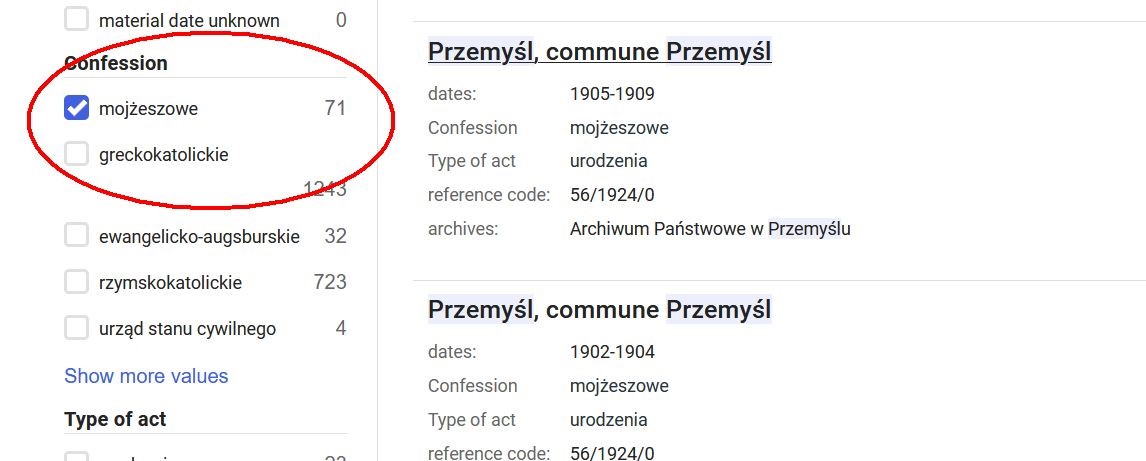
In case of Jewish records you click on mojżeszowe
- Kasa Stefczyka (Stefczyk bank)
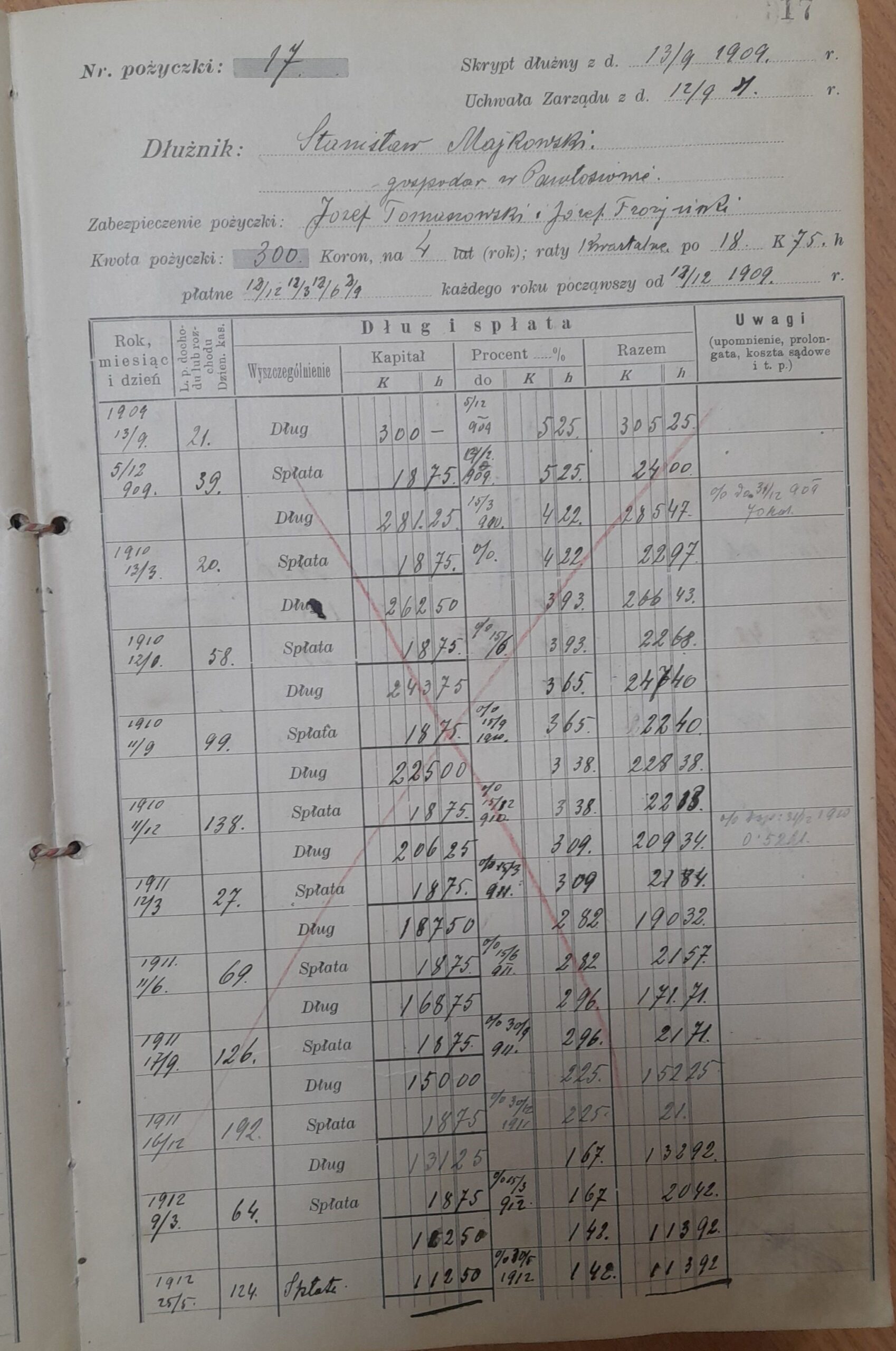
Stefczyk bank was very popular among ordinary people from the beginning of 20th century. These documents might be helpful to people who look for documents confirming Polish nationality of ancestors. The general rule in such proceedings is the more documents the better. In the picture below there is photo from the book of loans. We have here Stanisław Majkowski from Pawłosiów who borrowed 300 krones for 4 years. We have also names of two gurantors: Józef Tomaszowski and Jóżef Frożyński. He took this loan in 1909.
There are Stefczyk bank offices from districts of:
- Brzozów
- Gorlice
- Jarosław
- Krosno
- Lesko
- Lubaczów
- Mielec
- Nisko
- Przemyśl
- Przeworsk
- Ropczyce
- Strzyżow
- Tarnobrzeg
While looking for documents in case of Polish citizenship proceedings many people are especially interested in census, electoral records and military records. In case of census records there were census in Poland in 1921 and 1931 and these records should be in Lviv State Archive. Przemysl and the area belonged before WW2 to Lviv province. The same thing is in case of electoral records. They also should be in State Archive of Lviv.
The census during Austrian rules of Galicia was carried out 1785-1788 – Metryka Józefińska and then in 1820 – Metryka Franciszkańska and 3rd Galician cadaster was in 1850’s. However it is important to know that these three census included the farmer who owned the land or house. If they did not own anything we will not find them.
Military records can be found in Centralne Archiwum Wojskowe in Warsaw. They have military records of Polish soldiers in Great Britain, Haller Army https://en.wikipedia.org/wiki/Blue_Army_(Poland), records of Polish Soviet War of 1920 and soldiers in Polish Army from the time between WW1 and WW2.
Military records from the time o WW1 can be found in Vienna State Archive. List of soldiers who died, were wounded or who were prisoners of war can be found on Czech Digital library:
https://kramerius5.nkp.cz/search?field=all&value=1915
You type on advanced search the year you are interested in e.g. 1914
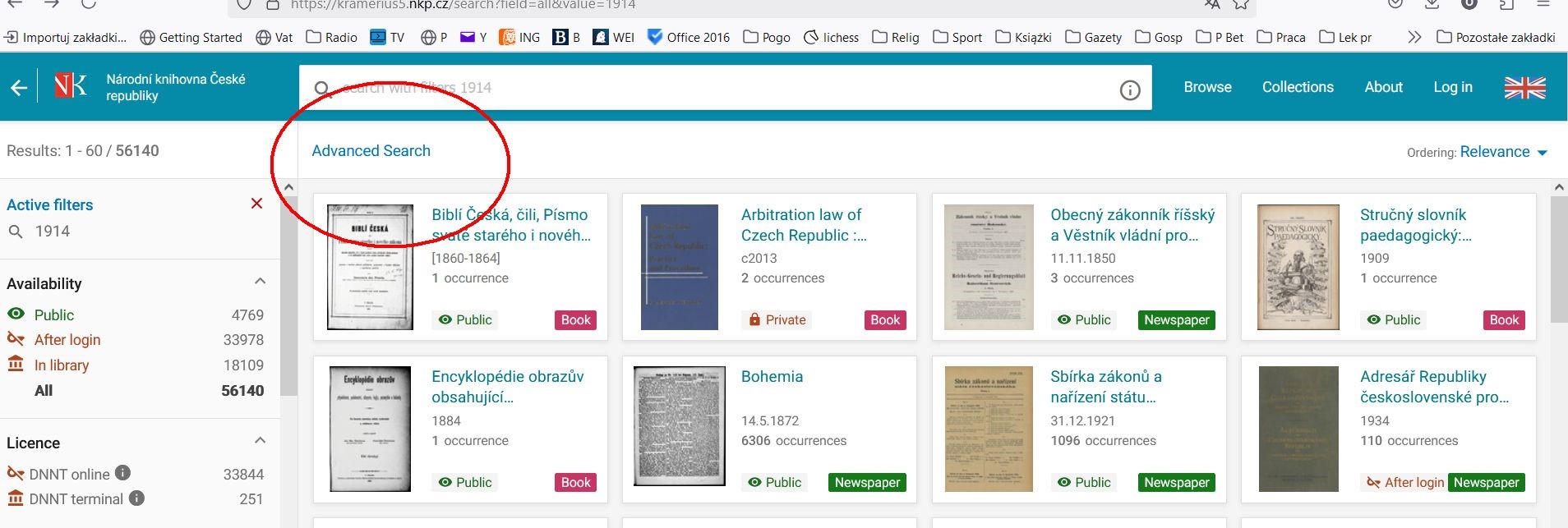
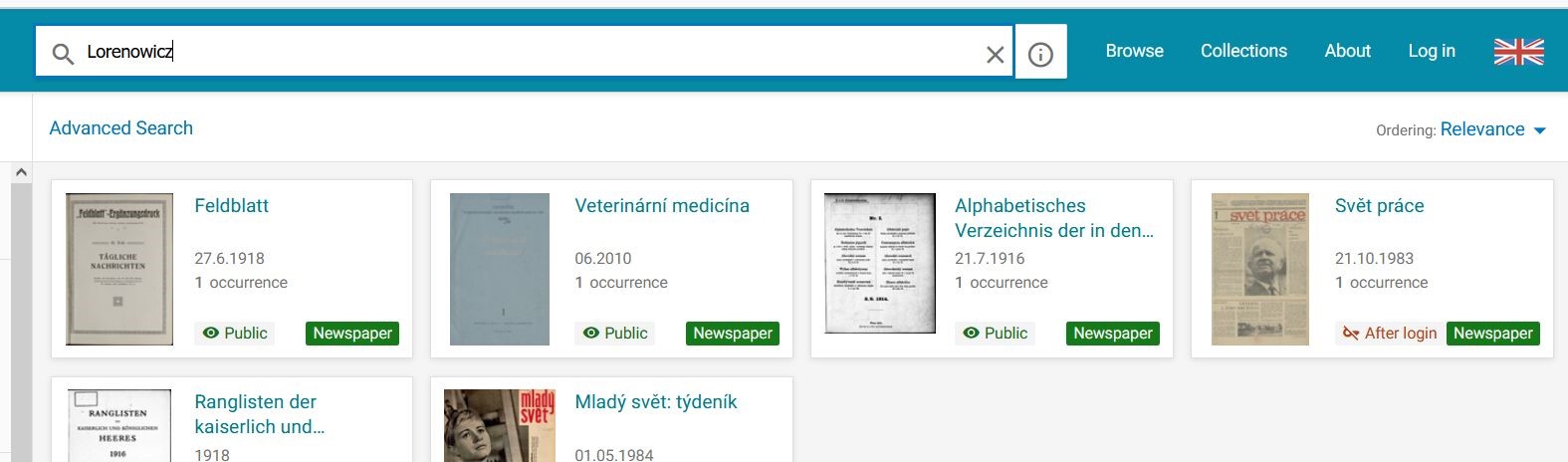
Then you type the last name of your ancestor (my relative was Lawrence Lorenowicz so I typed him):
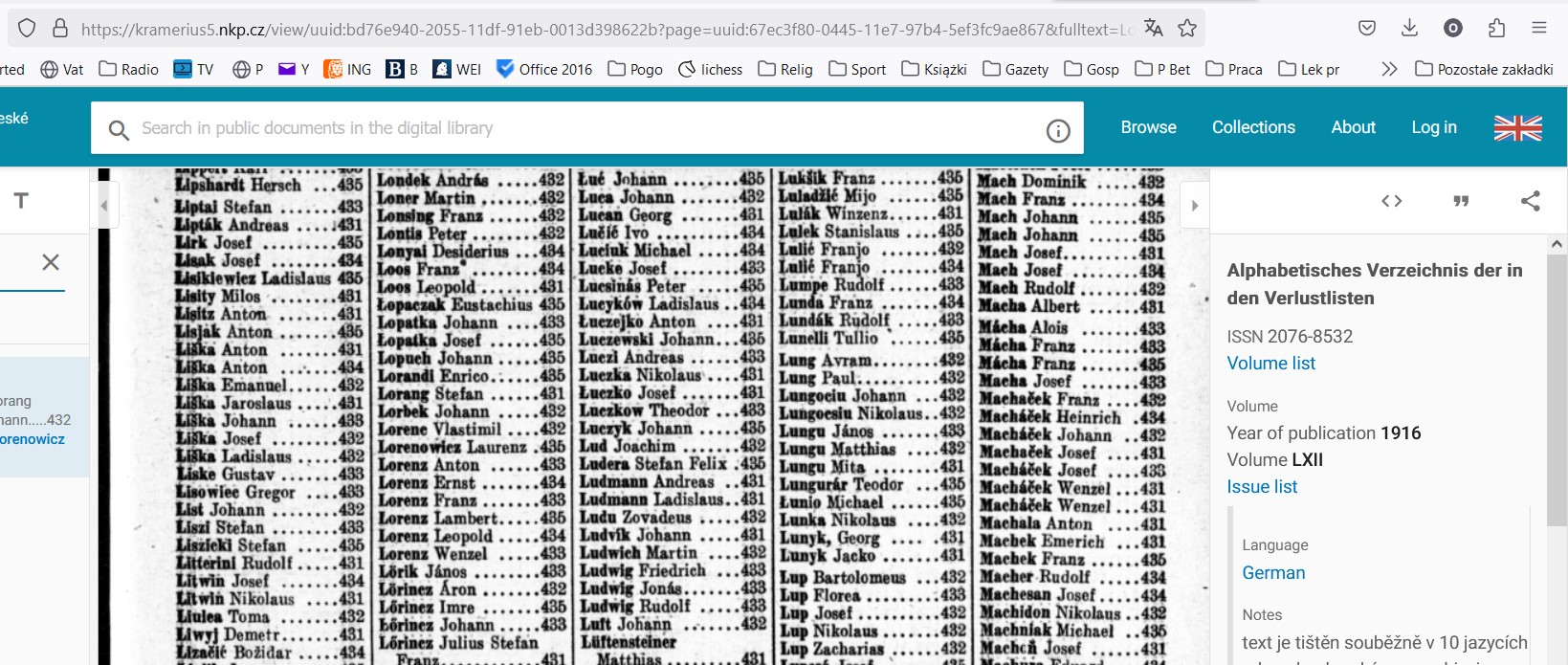
And I found him here:https://kramerius5.nkp.cz/view/uuid:bd76e940-2055-11df-91eb-0013d398622b?page=uuid:67ec3f80-0445-11e7-97b4-5ef3fc9ae867&fulltext=Lorenowicz
Understanding Cadastral Maps in Polish Archives
I would like to give some more hints regarding reading cadastral maps and so called „operats”.
As an example I chose town of Albigowa and farmer Grzegorz Niziol.
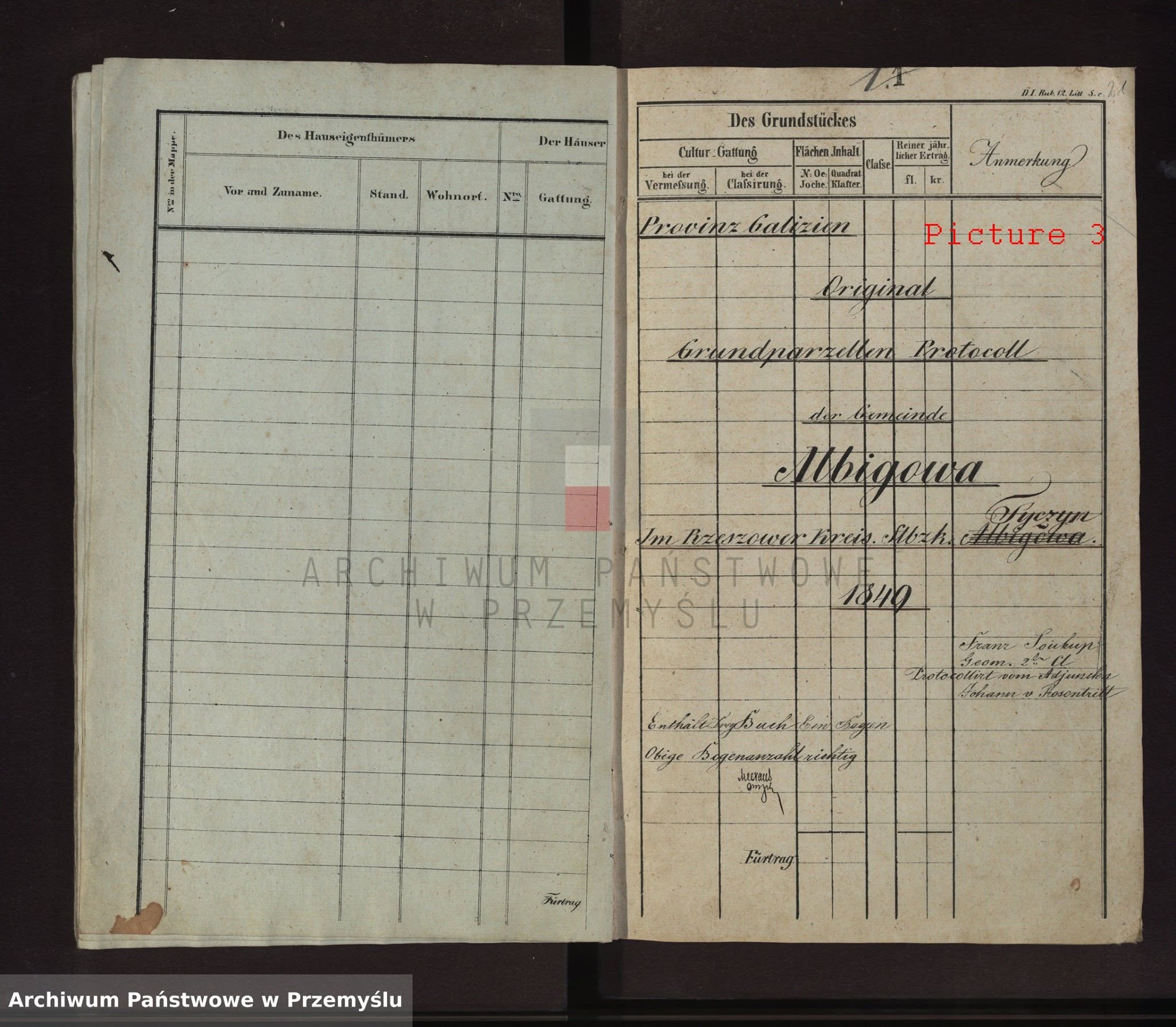
Picture 1 shows front page of the book Bauparzellen Protocol (building plots protocol)
I would like to give some more hints regarding reading cadastral maps and so called „operats”.
As an example I chose town of Albigowa and farmer Grzegorz Niziol.
Picture 1 shows front page of the book Bauparzellen Protocol (building plots protocol)

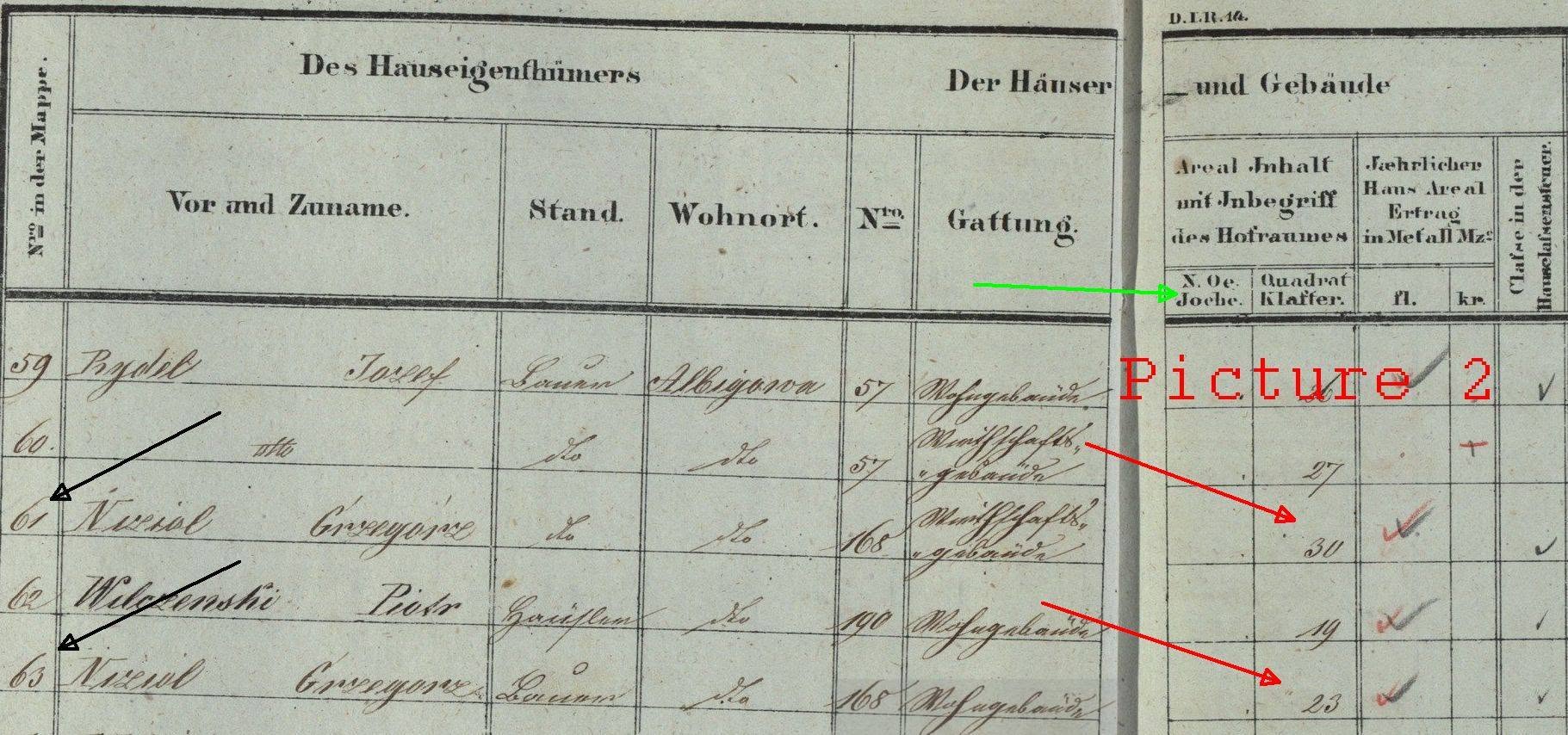
Picture 2 shows building plots 61 and 63 that Grzegorz Niziol owned (black arrows) which is on scan # 6
Plot 61 is 30 square Klafters – in English fathoms (1 fathom is 189 cm) (red arrows)
Plot 63 is 23 square fathoms
Green arrows shows another old measure unit which is Joch in German (in English morgen) and morga in Polish. 1 morg was 1600 square fathoms and this is 5755 square meters.
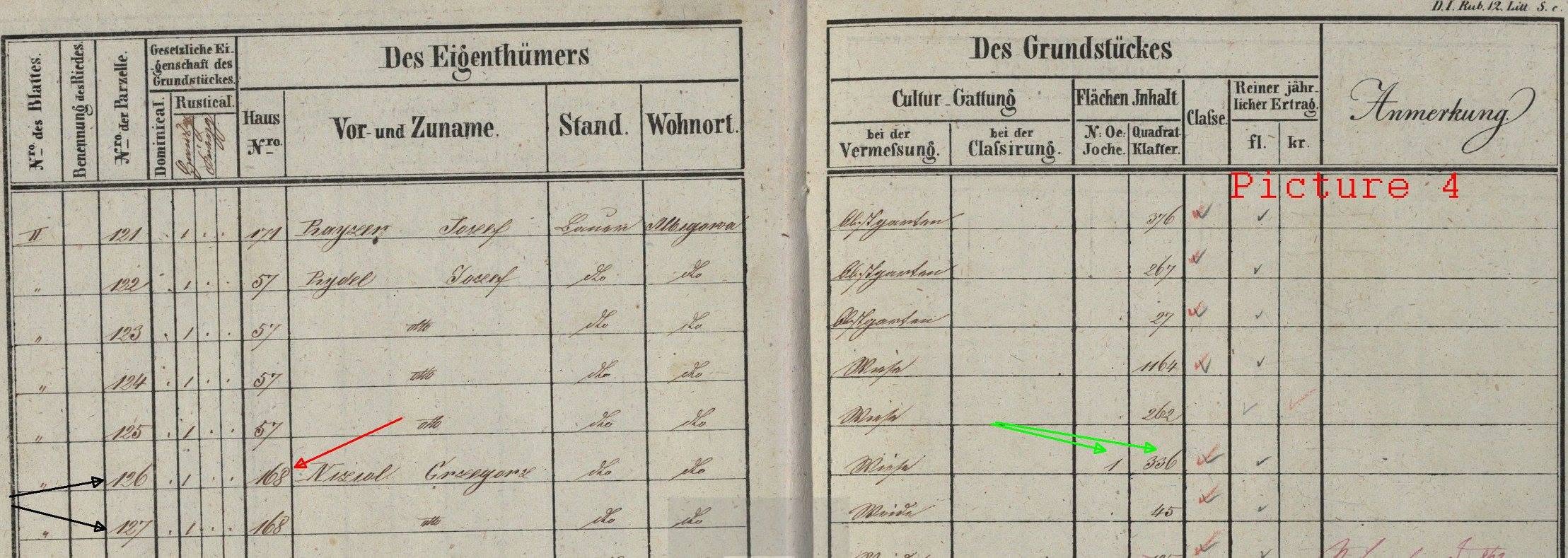
Picture 3 shows front page of Grundparzellen protocol (land lots) and this part followed the Bauparzellen Protocol. Link as above (scan #22)
Picture 4 shows land lots Grzegorz Nizioł owned: 126 and 127 (black arrows). House number was 168 (red arrow) The size of parcel 126 is 1 morgen and 336 square fathoms (green arrow) and the size of parcel 127 is 45 square fathoms.
Grzegorz Nizol owned more lands. Picture 5 shows land he owned and this is from alphabetical register of land owners link:
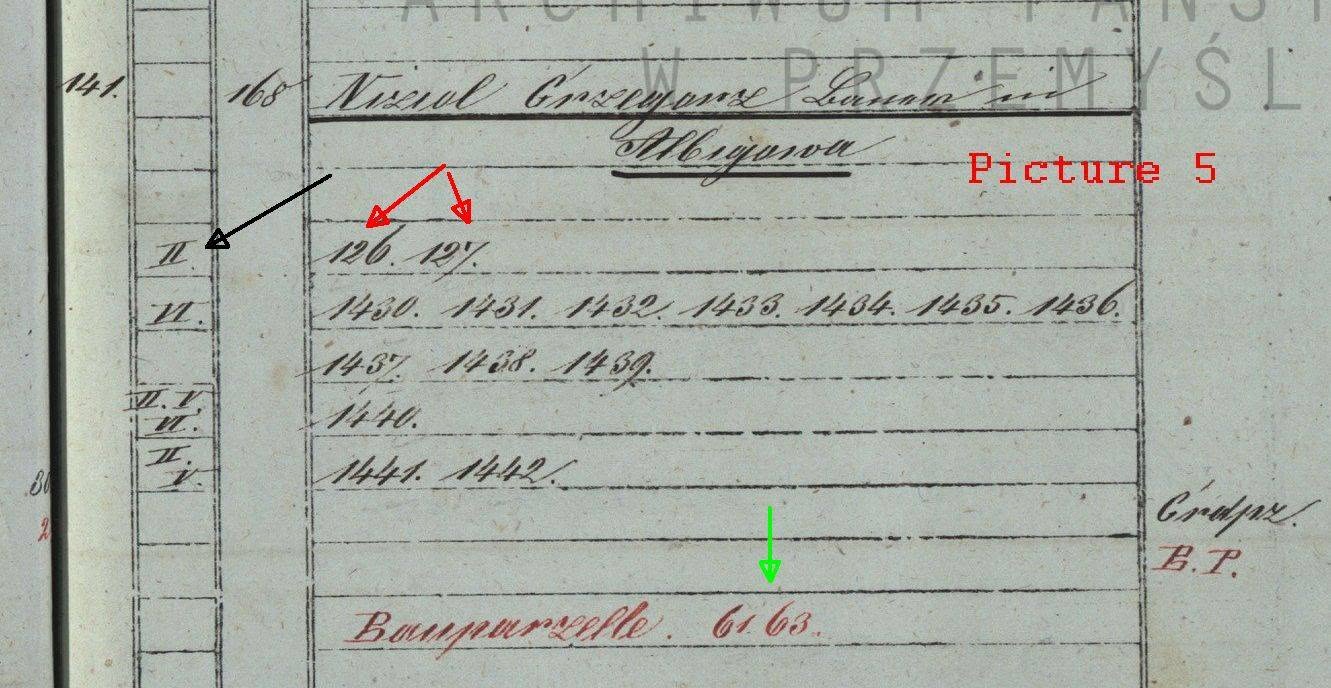
As you see on sheet II of the map (black arrow) there are land lots 126 and 127 (red arrows). His land can also be seen on sheets V and VI of the maps.
At the bottom there are building plots he owned – 61 and 63 (green arrow)
Picture 6 shows part of map – sheet II:
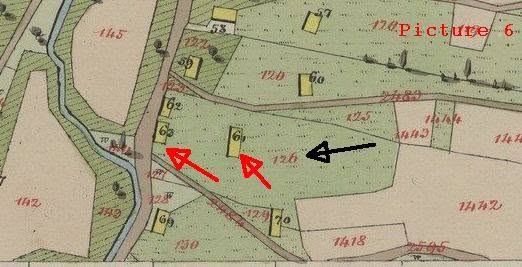
Red arrows shows building plots # 61 ad 63 that Grzegorz Niziol owned. Black arrow shows land lot 126 that he also owned.
Picture 2 shows building plots 61 and 63 that Grzegorz Niziol owned (black arrows) which is on scan # 6
Plot 61 is 30 square Klafters – in English fathoms (1 fathom is 189 cm) (red arrows)
Plot 63 is 23 square fathoms
Green arrows shows another old measure unit which is Joch in German (in English morgen) and morga in Polish. 1 morg was 1600 square fathoms and this is 5755 square meters.
Picture 3 shows front page of Grundparzellen protocol (land lots) and this part followed the Bauparzellen Protocol. Link as above (scan #22)
Picture 4 shows land lots Grzegorz Nizioł owned: 126 and 127 (black arrows). House number was 168 (red arrow) The size of parcel 126 is 1 morgen and 336 square fathoms (green arrow) and the size of parcel 127 is 45 square fathoms.
Grzegorz Nizol owned more lands. Picture 5 shows land he owned and this is from alphabetical register of land owners:
As you see on sheet II of the map (black arrow) there are land lots 126 and 127 (red arrows). His land can also be seen on sheets V and VI of the maps.
At the bottom there are building plots he owned – 61 and 63 (green arrow)
Picture 6 shows part of map – sheet II.
Red arrows shows building plots # 61 ad 63 that Grzegorz Niziol owned. Black arrow shows land lot 126 that he also owned.
Roman Catholic Archive of Przemysl
Please have a look below at the list of RC parishes that have 19th century records in Przemysl RC Archive. This list consists of old parish because now Przemysl Diocese consists of about 400 parishes. Some of these parishes have records back to 1784 and many of the m now belong to Rzeszow or Sandomierz Diocese. If your village is not on the list it is good to find out what was the parish. I recommend to download this book: https://polona.pl/…/e589624a-6e3e-4ee1-bbd8-20e3f1ee1d1f:
List of parishes that are now in Poland:
1. Albigowa
2. Babice
3. Bachórz
4. Bachórzec
5. Baligród
6. Bączal Dolny
7. Besko
8. Bieliny
9. Bieździedza
10. Bircza
11. Blizne
12. Błażowa
13. Boguchwała
14. Borek Stary
15. Bóbrka
16. Brzostek
17. Brzozów
18. Brzóza Królewska
19. Brzyska
20. Bukowsko
21. Chłopice
22. Chmielnik Rzeszowski
23. Cieklin
24. Czarna k. Łańcuta
25. Czudec
26. Dębowiec
27. Dobrzechów
28. Domaradz
29. Dubiecko
30. Dudyńce
31. Dukla
32. Dydnia
33. Dylągowa
34. Dynów
35. Dzikowiec
36. Frysztak
37. Futoma
38. Gać
39. Giedlarowa
40. Głogów Małopolski
41. Gniewczyna Łańcucka
42. Gogołów
43. Golcowa
44. Gorzyce Tarnobrzeskie
45. Górno k. Rzeszowa
46. Grabownica Starzeńska
47. Grębów
48. Grodzisko Dolne
49. Gwoźnica Górna
50. Haczów
51. Handzlówka
52. Harta
53. Harklowa
54. Hermanowice
55. Hoczew
56. Humniska
57. Husów
58. Hyżne
59. Iwonicz
60. Izdebki
61. Jaćmierz
62. Jarosław
63. Jasienica Rosielna
64. Jasień
65. Jasionka
66. Jasionów
67. Jasło
68. Jaśliska
69. Jawornik Polski
70. Jedlicze
71. Jeżowe
72. Kalwaria Pacławska
73. Kańczuga
74. Kaszyce
75. Klimkówka
76. Kobylany
77. Kołaczyce
78. Kombornia
79. Korczyna
80. Kosienice
81. Kosina
82. Kraczkowa
83. Krasiczyn
84. Krasne k. Rzeszowa
85. Krosno Fara
86. Krościenko Wyżne
87. Królik Polski
88. Krzemienica
89. Krzywcza
90. Kurzyna
91. Laszki
92. Lesko
93. Leszczawa Dolna
94. Leżajsk Fara
95. Lubatowa
96. Lubenia
97. Lubla
98. Lutcza
99. Łańcut
100. Łączki Jagiellońskie
101. Łąka
102. Łętownia k. Niska
103. Łężyny
104. Łowce
105. Łubienko
106. Łubno
107. Majdan Królewski
108. Majdan Sieniawski
109. Malawa
110. Manasterz
111. Markowa
112. Medyka
113. Medynia Głogowska
114. Michałówka
115. Tarnobrzeg-Miechocin
116. Miejsce Piastowe
117. Mrówla
118. Mrzygłód
119. Niebieszczany
120. Niebylec
121. Nienadówka
122. Nienaszów
123. Niewodna
124. Nowe Sady
125. Nowosielce Kozickie
126. Nowosielce Przeworskie
127. Nowotaniec
128. Nozdrzec
129. Odrzykoń
130. Osiek Jasielski
131. Osobnica
132. Ostrów k. Przeworska
133. Pantalowice
134. Pniów
134. Polana
135. Połomia
136. Poraż
137. Pruchnik
138. Przemyśl
139. Przeworsk
140. Przewrotne
141. Rzeszów-Przybyszówka
142. Przysietnica
143. Pstrągowa
144. Pysznica
145. Radawa
146. Radomyśl n. Sanem
147. Radymno
148. Raniżów
149. Rogi
150. Rokietnica
151. Stalowa Wola-Rozwadów
152. Równe k. Dukli
153. Rudnik. n. Sanem
154. Rudołowice
155. Rybotycze
156. Rymanów
157. Rzeszów-Fara
158. Rzeszów-Staromieście
159. Samoklęski
160. Sanok-Fara
161. Sarzyna
162. Sieklówka
163. Sieniawa Jarosławska
164. Siennów
165. Sietesz
166. Sławęcin
167. Rzeszów-Słocina
168. Sokołów Małopolski
169. Spie
170. Stany
171. Stara Wieś
172. Stobierna
173. Strachocina
174. Strzyżów
175. Stubno
176. Szebnie
177. Ślęzaki
178. Święcany
179. Świlcza
180. Targowiska
181. Tarnawiec
182. Tarnowiec
183. Trzciana
184. Trzcinica
185. Trzeboś
186. Trześń
187. Trześniów
188. Tuligłowy
189. Turbia
190.Tyczyn
191. Tyrawa Wołoska
192. Uherce
193. Ujkowice
194. Ulanów
195. Urzejowice
196. Ustrobna
197. Wesoła
198. Wiązownica
199. Wielkie Oczy
200. Wielowieś k. Tarnobrzega
201. Wola Rafałowska
202. Wola Zarczycka
203. Wołkowyja
204. Wrocanka
205. Wrzawy
205. Wysoka Łańcucka
206. Zabierzów
207. Zaczernie
208. Zagórz
209. Zaleszany
210. Załęże
211. Zarszyn
212. Zarzecze Jarosławskie
213. Zgłobień
214. Zręcin
215. Żmigród Nowy
216. Żmigród Stary
217. Żołynia
218. Żurawica
Please have a look at the list of RC parishes with records from19th century in RC Archive in Przemysl that are now in Ukraine:
1. Biskowice
2. Błozew
3. Bruchnal
4. Czyszki
5. Chyrów
6. Czukiew
7. Drohobycz.
8. Dublany
9. Felsztyn
10. Husaków
11. Jaworów
12. Kalinów
13. Komarno
14. Krakowiec
15. Krukienice
16. Łanowice
17. Medenice
18. Miżyniec
19. Mościska
20. Mużyłowice
21. Myślatycze
22. Niżankowice
23. Nowe Miasto
24. Ożomla
25. Pnikut
26. Podbuż
27. Radochońce
28. Równe
29. Rudki
30. Rumno
31. Rychcie
32. Sambor
33. Sądowa Wisznia
34. Sąsiadowice
35. Stara Sól
36. Stary Sambor
37. Stojańce
38. Strzałkowice
39. Tuligłowy ad Komarno
40. Turka
41. Wojutycze
42. Wołoszcza